
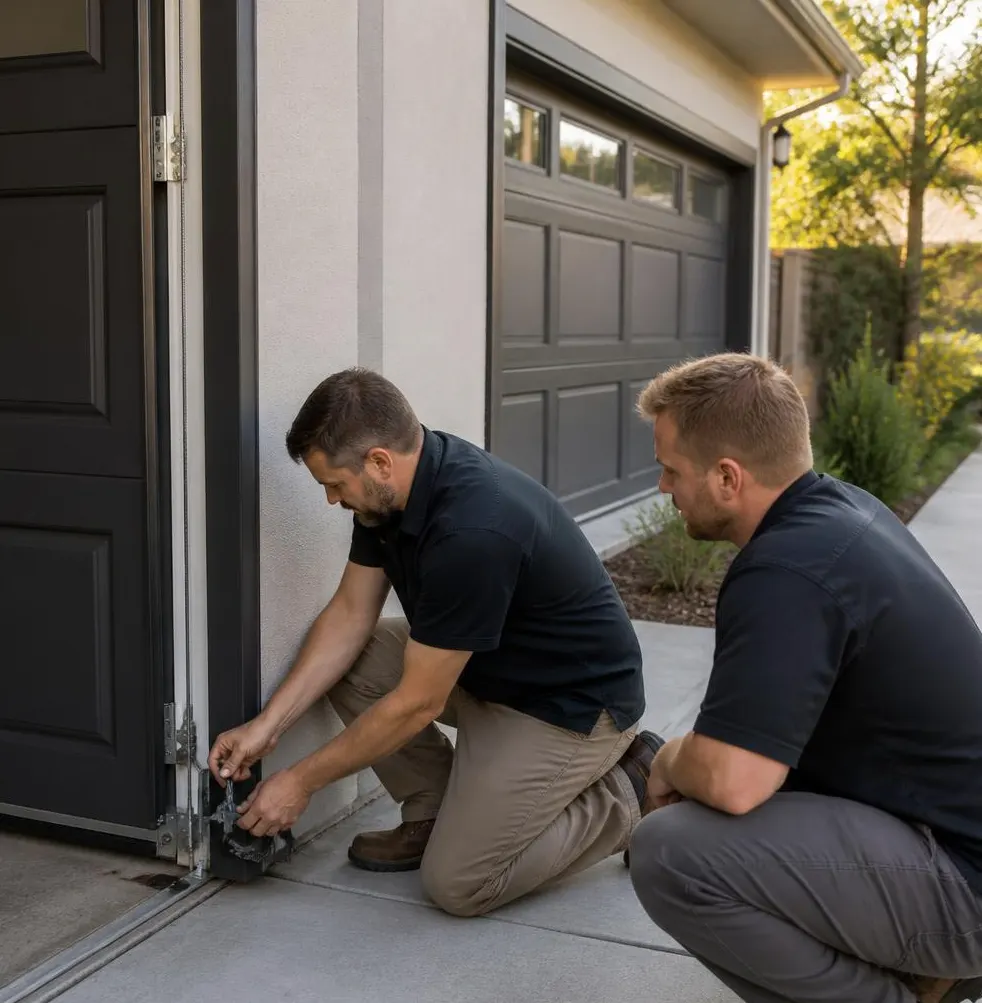
Leave an opener's force and travel limits misadjusted through another rainy season and you're not just living with an annoying door. You're looking at a bent track or a cracked panel from a door that's slamming shut too hard (commonly a $250–$500 repair), a burned-out motor from an opener that keeps straining against resistance it was never set up to handle (often $200–$1,000 to replace), or a safety reversal that fails right as a kid or pet is underneath the door. One of those outcomes costs money. The other isn't worth risking to win an argument about whether the door is "fine."
What Force and Travel Limits Actually Mean
Travel limits tell the opener exactly where the door should stop when fully open and exactly where it should stop when fully closed. Set them wrong and the door either grinds against the top of the track, reverses before it touches the floor, or doesn't fully seat against the weatherstripping.
Force tells the opener how hard to push or pull to get the door moving against resistance — a cold, stiff spring, dust-caked rollers, dragging weatherstripping. Too much force and the opener will shove right through a problem it should be stopping for. Too little, and the door hesitates, reverses for no clear reason, or won't close at all.
Why the Wrong Setting Actually Damages the Door
This is the part worth sending straight to whoever thinks "just crank it up" is a fix. Excess force doesn't solve a sticking door — it hides the real problem. A weakening spring, a slightly bent track, or rollers that need lubrication all create resistance. Instead of that resistance getting fixed, the opener just muscles through it every single time. That accelerates wear on gears, cables, and hinges, and it defeats the auto-reverse safety feature that's supposed to stop the door if it meets an obstruction.
Too little force causes a different kind of damage. The door stops short of fully closing or reverses mid-cycle, which means the motor is working overtime on repeated attempts. In a winter storm, a door that won't fully seat lets wind-driven rain in under the bottom seal. In a dry, dusty stretch, it lets grit and ash work into the track and rollers, which then adds resistance back into the system — a cycle that gets worse, not better.
The Two-Minute Test to Settle the Argument
Skip the debate and run this test together:
- Down test: Lay a 2x4 or a roll of paper towels flat on the ground where the door closes. Trigger the close cycle. The door should stop and reverse within an inch or two of contact. If it pushes through or crushes the object, force is set too high. If it reverses well before touching anything, the force or limit setting is too sensitive.
- Up test: Run the door to fully open. It should stop smoothly and hold — no straining, no jerking back down, no grinding sound at the top of the track.
- When to rerun it: After any spring replacement, after a big temperature swing, after cleaning or lubricating the track, and once a season as weather shifts. Settings that were correct in August don't automatically hold through December.
What Changes With the Season
Through a long dry stretch, grease on rollers and hinges hardens, and dust or wildfire smoke residue settles into the track, adding friction the opener has to push through. Many owners respond by bumping the force up — then forget to dial it back down once the hardware gets cleaned and relubricated.
As winter rain moves in, wood doors and jambs can swell slightly and weatherstripping expands, adding drag the opener wasn't tuned for. A door that closed smoothly in October might start hesitating or reversing in January for no obvious reason — it's not broken, it's responding to moisture the force setting never accounted for.
Cold nights in the inland valley can also stiffen spring tension and lubricant just long enough for the first cycle of the day to behave differently than the rest. If the door seems fine by afternoon but sticky first thing in the morning, that's often the clue.
The Real Trade-Off
Cranking force up is a quick fix that feels like a win in the moment, but it just transfers wear from the symptom (a sticky door) to the system (motor, gears, cables, panels). The better approach: fix the mechanical cause first — lubricate the rollers and hinges, check the track alignment, confirm spring tension is correct — then set the force to the lowest level that reliably closes the door, and set the limits so it seats snug without slamming.
When to Call La Verne Garage Door
If the 2x4 test fails, if the door reverses unpredictably, or if the opener is grinding, straining, or cycling more than once to close, that's a sign the force and limit settings need a proper reset — not another guess at the dial. Our Garage Door Opener Repair & Installation service includes checking limits, force, and the safety reversal system against manufacturer specs, and our Garage Door Maintenance visits catch the track misalignment, roller wear, or spring tension issues that cause owners to compensate with force settings in the first place. If the door is stuck wide open or won't budge at all, our emergency service can get it moving safely the same day.
If this argument has been going on in your house for more than one season, let us settle it. Call La Verne Garage Door for a straightforward inspection and correct opener settings, done right the first time, right here in La Verne, CA.